Showing posts with label American Vehicle. Show all posts

Saturday, March 27, 2021

The Car of Brigadier A.W.S. mallaby


Many of the questions surrounding the death of British Brigadier AWS Mallaby in Surabaya have not yet been answered. For example, it has never been clarified in which car this British officer was driving - a not unimportant detail, isn't it?

By Bert Immerzeel

I do not really consider myself a big car enthusiast, and I am certainly not the type that will quickly get into a conversation with other men at birthday parties about the pulling power of the new diesel engine of the VW Passat or the design of the Alfa Romeo. But still, I have to admit, the subject sometimes touches me. And I think that has everything to do with my own 15 year old BMW. My wife regularly sighs: "Buy a new car, it's getting too old!", To which I keep coming up with the same defense: "but he still works, right?"

The funny thing is, the longer I drive my own car, the harder I find it to part with it. And well, if that may be called 'loving', then that's just 'loving'. And so I slowly but surely start to become more interested in the stories of others, assuming that they (of course: men) also have such a connection with their car.

Mallaby's car

So it happened that recently I suddenly became curious about Mallaby's car.

Perhaps a brief explanation is in order here. Historical events or periods are sometimes better explained by a single photo than by dozens of books or articles. When it comes to the war period in the Dutch East Indies, some photos always stand out because they have a more symbolic value than others: for example, that photo from the Japanese era with women bowing in an internment camp, or the photo from 1945 of the car of British Brigadier AWS Mallaby in Surabaya (another photo is known of that car, probably from a few days earlier).

The flame in the pan

Much has been written about Mallaby's death on October 30, 1945, but not all questions have been answered. The assassination of the British army commander was one of the crucial moments in Surabaya that gave rise to the Battle of Surabaya. Mallaby, who hoped to relieve some of his troops in the Internatio building at Willemsplein through negotiations with the Indonesians, had gone almost unarmed among the people in a car driven by an Indonesian. With him in the backseat were Captain RC Smith and Captain TL Laughland. According to a later report by Smith, the men were disarmed at some point, but Laughland managed to hide another hand grenade. The driver got out and left the car in the midst of the crowd. As darkness fell, the British in the Internatio building fired at the crowd and a firefight ensued between the two sides. The disarmed Mallaby was shot dead at close range by an Indonesian while he was still in the back seat. The other two men threw out the grenade and jumped into the Kali Mas. A few hours later, and with a wet suit, they were able to establish communication with their troops in Tandjoeng Perak.

So much in brief is happened on Willemsplein. Because it has never been known who actually killed Mallaby, nor because it could not be established with 100% certainty that the British were the first to open fire, hundreds, if not thousands, of research pages have been devoted to this event. And most of this material is still "classified" in British government safes. What has been published, however, focuses entirely on the question of the actions of the protagonists involved, and reveals little or nothing of the technical details. And, surprisingly enough: not even an article about the car itself!

The LaSalle Sedan

What brand is that car actually from? - I wondered when looking at the famous photo. In search of the answer, I could not come up with much else than to compare the car with images on the internet. After some surfing I thought I had found the answer. It looked very much like a 1940 or 1941 Chevrolet Sedan. At the same time, I knew this was wrong. Some details (the grille, the headlights, the window bars) were slightly different from that Chevy. But then what was it?

Because I couldn't figure it out, I put the question to a friend who I knew is such an automan-man. And yes, less than an hour later I had the answer: Mallaby was sitting in a LaSalle 1940 series 52 Sedan when he was shot dead. Without any doubt!

The LaSalle, like the Chevrolet and Cadillac, is a chic car brand from the General Motors factories. And this immediately explains why they look so similar at first glance. The brand was launched by GM in 1927 to fill a price gap: the American middle class needed a better car than the Buick, but did not yet have enough income for a Cadillac. The cheapest LaSalle was still a hefty investment with its price of $ 2685. The name - like that of the Cadillac - came from a French 17th century explorer. In 1940 the brand was withdrawn from the market because it was outstripped by other models and sales figures had fallen too much.


Gray, dark gray

Even though we now know which car Mallaby was in, many other questions of course remain unanswered. Who owned this car? It is well known that the LaSalles were imported into the Dutch East Indies before the war. However, were cars still shipped from the United States to the Dutch East Indies in 1940? If the latter was the case, then this car would of course have been confiscated in 1942 and used by the Japanese for three years.

The strength of the photo is of course largely in the contrast between the pathetic car wreck ('the colonial power') and the proud Republican sign behind it. This also begs the question of whether the picture was not directed for political reasons.


The image shows few other details. We even have to guess about the color of the car. However, given the outcome of the vehicle and its occupants, I stick to gray, dark gray.

Thanks to Gjalt van der Molen, the man who knows so much about cars!


Source :
https://javapost.nl/2010/12/14/de-auto-van-mallaby/

Thursday, June 23, 2016

M3 Stuart Tank in Indonesia

Dutch M3 Stuart tank of zesde-eskadron Vechtwagens Huzaren van Boreel crossing the river in Indonesia during the Revolutionary War. The M3 Stuart, formally Light Tank M3, is an American light tank of World War II. It was supplied to British and Commonwealth forces under lend-lease prior to the entry of the U.S. into the war. Thereafter, it was used by U.S. and Allied forces until the end of the war. The name General Stuart or Stuart given by the British comes from the American Civil War Confederate General J.E.B. Stuart and was used for both the M3 and the derivative M5 Light Tank. In British service, it also had the unofficial nickname of Honey after a tank driver remarked "She's a honey". To the United States Army, the tanks were officially known only as "Light Tank M3" and "Light Tank M5". The M3 Stuarts were the first American-crewed tanks in World War II to engage the enemy in tank versus tank combat.


M3 Stuart Tank of zesde-eskadron Vechtwagens Huzaren van Boreel in Indonesia. After the 2nd Police Action and the end of combat operations, began a long period of waiting for the return to the Netherlands. The transfer of territory and thus jurisdiction to the TNI took some time. To pass the time they organized some kind of activities in their camp in Solo, including sports. There were also organized trips, for instance, to Borobudur.

Source :
https://sites.google.com/site/zesdeeskadron/6-e-tweede-politionele-actie-deel-2

Sunday, March 6, 2016

A Chevrolet 1936 in Transport Museum, Malang

A nice Chevrolet 1936 at TransportMuseum (Musium Angkut) in Kota Batu, Malang (East Java). General Motors (GM) has been in operation before the Indonesian state is formed. Precisely when Indonesia was still under Dutch colonial grip. In 1927, the forerunner to the GM, who was named NV General Motors Java Handel Maatschappij (NVGMJHM), established in Indonesia. Two years later, General Motors for the first time introduced their six-cylinder-engine-car. Because of the high demand, GM consequently decided to build a plant in Tanjung Priok in 1938. The Chevrolet factory later became the first car manufacturer in Indonesia. But General Motors was forced to stop producing after Japan's entry into Indonesia in 1942.


Source :
http://www.alamy.com/search.html?CreativeOn=1&adv=1&ag=0&all=1&creative=&et=0x000000000000000000000&vp=0&loc=0&qt=malang%20museum&qn=&lic=6&lic=1&imgt=0&archive=1&dtfr=&dtto=&hc=&selectdate=&size=0xFF&aqt=&epqt=&oqt=&nqt=&gtype=0
http://www.otonusa.com/2015/03/kisah-sepak-terjang-sejarah-chevrolet.html

Dodge Truck with Dutch Troops

This colorized photo showing a military style truck which is a Dodge WC of World War II vintage and this one looks to be a WC52 weapons carrier.


Source :
https://www.facebook.com/groups/1529678470646757/

Ford Truck Passing in Front of St. Aloysius Broederschool

Two women sit while selling goods on the Koningsplein (King's Square) in old Batavia (now Jakarta). The civilian style truck passing in the background is a 1946-1948 Ford (you can identify it by the distinctive louvers in the side of the motor hood). Behind you can also see the St. Aloysius Broederschool. The picture was taken by Cas Oorthuys between 1 January 1947 to 28 February 1947.


Source :
http://www.geheugenvannederland.nl/?/en/items/NFA02:cas-10023-11

Oranje Hotel in the 1930s

Oranje Hotel (now Hotel Majapahit) in Tunjungan Street, Surabaya. The only car I (Bill) can make a good guess at is the first one which looks to me like a 1934 Chevrolet Touring Car.


Source :
https://id.wikipedia.org/wiki/Berkas:Hotel_oranye_1911.jpg

Assortment of Cars in front of Internatio Building

Internatio (Internationale Handels-en Credietvereniging Rotterdam) building in Surabaya in 1931 (the caption in the picture is wrong). The picture show Assortment of mostly sedans and, possibly a mix of Buick and Chrysler vehicles. Looks like a hire cars for tourists or businessmen visiting Indonesia / Netherlands East Indies in the early 1930s.  "High Class Taxis" you might call them!


Source :
http://intijiwa33.blogspot.co.id/2013/02/surabaya-dulu-dan-sekarang.html

Monday, February 22, 2016

Convertible Cars at Jalan Tunjungan Surabaya

Jalan Tunjungan (Tunjungan Road) in Surabaya. This picture shows more than 30 cars that would have been very expensive in the day, and they may be a mix of Buick and Chrysler vehicles, all 4 door convertibles. This could be some sort of a car community.


Source :
http://henryaskme.blogspot.co.id/2011/04/poto2-penuh-nostalgia.html

Jalan Tunjungan in the 1950s

Jalan Tunjungan (Tunjungan Road) in Surabaya, circa 1950s. The picture is facing to the north side in front of the Orang Majapahit Hotel, next to the market (Pasar). For the identification of the vehicle, from left to right: a 1939 Buick, an Austin A40 Somerset (everything fits except the lower grille but this may be an aftermarket accessory). Next an Opel Olympia Rekord of ca 1953 in the background. Finally on the right, a 1948 Nash (Super 6 or Ambassador).


Source :
https://rajaagam.wordpress.com/2008/10/24/surabaya-masa-lalu-2/jalan-tunjungan-difoto-tahun-1930-menghadap-ke-utara-dari-depan-hotel-orang-majapahit-persis-di-depan-pasar-tunjungan-dok-yousri-dari-surabaya-tempo-dulu1/

Ford Model A in Surabaya

Societeitsraad building in Surabaya in 1930. The vehicle at left is a Ford Model A panel van. The Ford Model A (also colloquially called the A-Model Ford or the A, and A-bone among rodders and customizers), was the second huge success for the Ford Motor Company, after its predecessor, the Model T. First produced on October 20, 1927, but not sold until December 2, it replaced the venerable Model T, which had been produced for 18 years. This new Model A (a previous model had used the name in 1903–04) was designated a 1928 model and was available in four standard colors. By 4 February 1929, one million Model As had been sold, and by 24 July, two million. The range of body styles ran from the Tudor at US$500 (in grey, green, or black) to the Town Car with a dual cowl at US$1200. In March 1930, Model A sales hit three million, and there were nine body styles available. Model A production ended in March, 1932, after 4,858,644 had been made in all body styles. Its successor was the Model B, which featured an updated 4-cylinder engine, as well as the Model 18, which introduced Ford's new flathead (sidevalve) V8 engine.


Sources :
https://en.wikipedia.org/wiki/Ford_Model_A_%281927%E2%80%9331%29
https://www.pinterest.com/winahjusedyana/sejarah-soerabaia/

International Harvester and CMP Truck in Simpang Road

Jalan Simpang (Intersection Road), Surabaya (East Java), circa 1947. The truck with long passenger lorry is a International Harvester M5H6, while the military truck at right is a CMP, probably a Chevrolet 30 CWT.


Source :
http://lokasiwisatadiindonesia.blogspot.co.id/2012/10/old-surabaya.html

Dutch Soldiers in a Jeep in Front of Kemayoran Mosque

Kemayoran Mosque (Masjid Kemayoran) in Surabaya, 1949. Some Dutch 'tourists' boarded Willys MB type 1944 jeep and posed in the artificial crossing in front of the mosque.


Source :
https://www.pinterest.com/pin/342836590357948517/

Gouverneurs Kantoor Oost-Java in Surabaya

Surabaya in 1929-1930. The building is Gouverneurs Kantoor Oost-Java, designed by architect W. Lemei while the constructor was Ballast Ned. AAnn. Mij (NEDAM). Now becoming the office for the East Java governor. The truck in the foreground is International Harvester M5H6 2½ ton. They were originally supplied to the US Marine Corps and the US Navy. I (Bill) cannot yet identify the car on the left nor can I identify the crawler tractor on the trailer.


Source :
http://surabayainfowisata.blogspot.co.id/2015/08/kantor-gubernur-jatim-tempoe-doeloe.html

Thursday, February 11, 2016

AA Gun Mounted on an Open Passenger Car

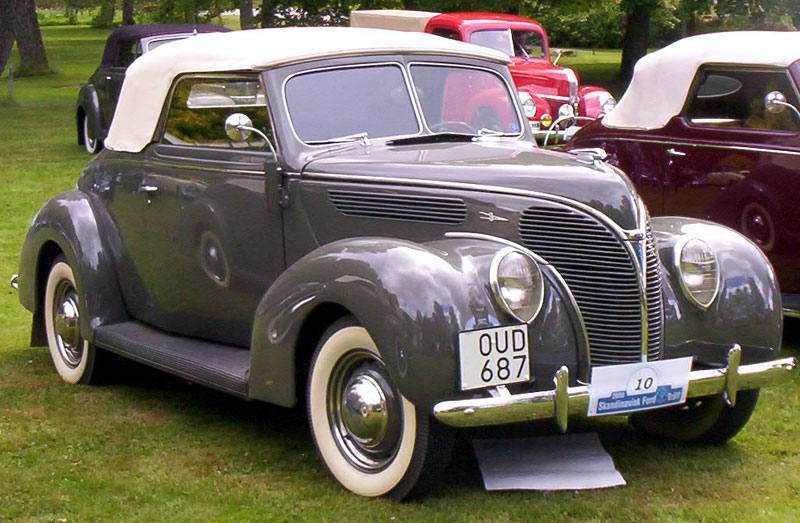
Two soldiers of the Republican army (Indonesia) manning a mobile anti-aircraft gun mounted on a 1938 Ford Model 81A 760B De Luxe Club Convertible with non standard wheels and tyres (I can imagine the wire wheels were fitted for more ground clearance). Indonesia, 1947


Source :
http://www.zonaunik.com/2011/09/foto-foto-jaman-perang-kemerdekaan.html

Dutch Machine Gunners in the Battle of Palembang

This one is a workshop conversion of either a 1938 or 1939 Ford from a sedan to a pickup truck. As the grille and entire engine hood are missing, I (Bill) cannot tell for sure which year it is and can only go by the headlamps which were identical on both years. The picture was taken by W.F.J. Pielage (a Dutch soldier) in Palembang, January 1946.


Source :
http://indonesia-zaman-doeloe.blogspot.co.id/2015/09/palembang-di-saat-perang-kemerdekaan.html

Parade of KNIL Engineers in Andir Square

The military parade of KNIL engineers company in Andir Square (Bandung) after the handover ceremony for the office of Commander-in Chief of the Koninklijk Nederlands Indisch Leger (Royal Netherlands East Indies Army; KNIL) from Lieutenant-General Murk Boerstra to Lieutenant-General Gerardus Johannes Berenschot, July 1939. From left to right are: 1938 Chevrolet truck; 3-4 1938 Chevrolet trucks; In front of them a Bedford ASYC; To the rear, a 1939 Chevrolet truck; Another 1938 Chevrolet truck; A 1939 Chevrolet truck; and at the far right is another Bedford ASYC.


Source :
http://indonesia-zaman-doeloe.blogspot.co.id/2015/09/defile-kesatuan-zeni-knil.html

Wednesday, February 10, 2016

Scorched Earth Policy of Indonesian Troops in a Car Dealership in Purwokerto (1947)

Republicans (Indonesian troops) have destroyed the central car dealership of Purwokerto and set it on fire before the city was occupied by Dutch troops. These pictures were taken by Hugo Wilmar in the Dutch First Police Action (Eerste politionele actie), Central Java, Indonesia, July 27, 1947.


The photo of what seems to be a car dealership may be the Ford dealer in Purwokerto. There are three Ford cars in front of the demolished building that are of the 1946-1947 style and some older Fords in what is left of the building.


In this photo, you can see many six cylinder motors with the cylinder head removed.  Ford did make such an engine at that time and it looked at least similar to the ones in the photo above.


This photograph show a half-cropped truck at right with speakers on the front grille.  I (Bill) believe this is a CMP (Canadian Military Pattern) 30 CWT truck with propaganda speakers mounted on it.


Source :
http://www.geheugenvannederland.nl/?/nl/items/SFA04:SFA006000631

Tuesday, February 9, 2016

Dutch Soldiers on a Vacation in Cilincing Beach

In the middle of the Indonesian Independence War, Dutch soldiers still have time for fun in the beach. These pictures were taken in 2 August 1947 by photographer Hugo Wilmar and showing Dutch soldiers sunbathing in Cilincing Beach (Jakarta) with their spouses. The truck is a Canadian CMP 30 CWT 4x4


 A rear view of Dodge WC62 or WC 63 Weapons Carrier.  The difference is the 62 has no winch and the 63 does have one. 1.5 ton 6x6.


The vehicle in order, from front to back, are: A Citroën 11 (which could be prewar or postwar), a 1946 Chevrolet, and a 1947 Hudson.


Source :
http://www.geheugenvannederland.nl/?/en/items/SFA04xxCOLONxxSFA006000639/&p=2&i=3&t=407&st=Hugo%20Wilmar&sc=%28creator%20all%20%28Hugo%20%20AND%20Wilmar%29%29%20OR%20%28contributor%20all%20%28Hugo%20%20AND%20Wilmar%29%29/&wst=%22Hugo%20Wilmar%22

Dutch Military Column in Mount Slamet

These pictures was taken by Hugo Wilmar and shows a Dutch military column in the eastern slope of Mount Slamet area, Central Java, during the first Police Action (politionele actie), 27 July 1947. They were from V-brigade under colonel "Jantje" Meijer. The first two armored vehicle are Stuart M3A1 light tanks with a Canadian origin CMP C 15TA armoured car in the back.


The second picture shows the same tanks with a White M3A1 Scout car in the lead.  Note that the M3A1 was supplied with both a closed and an open drivers cabin!


 Stuart M3A1 light tank followed by Canadian origin CMP C 15TA armoured car


 A Canadian CMP 30 CWT 4x4 towing artillery, rear view.


Source :
http://www.geheugenvannederland.nl/?/nl/items/SFA04:SFA002001237

Sunday, February 7, 2016

Dutch Soldiers Interrogating Civilian

Interrogation of civilian by Dutch soldiers to check the damage of Christian property (church) by unknown mob in Depok, 11 April 1946. The picture was made by Willem van de Poll. The vehicle is Willys MB jeep, used extensively by Dutch forces in Indonesia.


Source :
http://indonesia-zaman-doeloe.blogspot.co.id/2016/01/tentara-belanda-memerika-insiden.html