Showing posts with label Passenger. Show all posts

Monday, February 22, 2016

International Harvester and CMP Truck in Simpang Road

Jalan Simpang (Intersection Road), Surabaya (East Java), circa 1947. The truck with long passenger lorry is a International Harvester M5H6, while the military truck at right is a CMP, probably a Chevrolet 30 CWT.


Source :
http://lokasiwisatadiindonesia.blogspot.co.id/2012/10/old-surabaya.html

Thursday, February 11, 2016

AA Gun Mounted on an Open Passenger Car

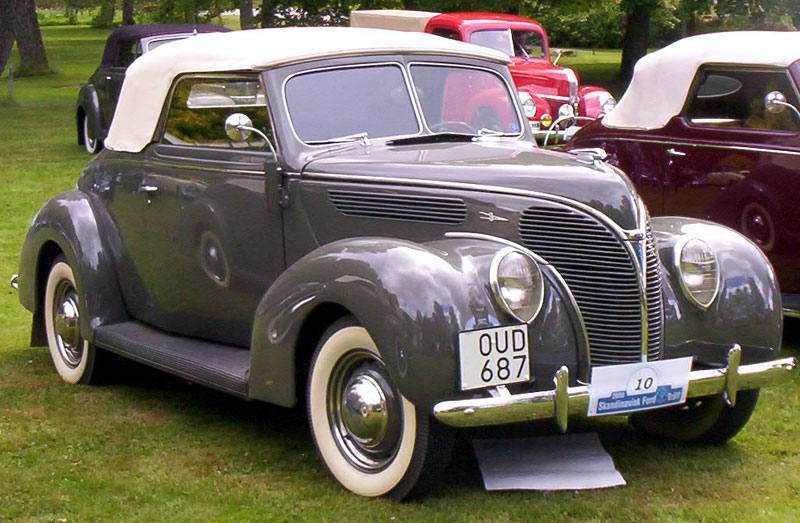
Two soldiers of the Republican army (Indonesia) manning a mobile anti-aircraft gun mounted on a 1938 Ford Model 81A 760B De Luxe Club Convertible with non standard wheels and tyres (I can imagine the wire wheels were fitted for more ground clearance). Indonesia, 1947


Source :
http://www.zonaunik.com/2011/09/foto-foto-jaman-perang-kemerdekaan.html

Monday, February 1, 2016

Convoy of Dutch Troops in Indonesian Road

Convoy of Dutch troops in Indonesian road. The vehicles are as follow (from the front):
1.Willys MB
2.Opel Admiral which were built 1937-1939
3.Ford truck. There were two series built, 1942-43 and 1945-1947 that were almost identical
4. Dodge WC "Weapons Carrier"  This one is likely a WC56 Command Car without winch..
5. Possibly another Ford truck.
6&7. Can't positively identify due to the lack of details in the photo.


Source :
https://www.pinterest.com/isabella161/nederlands-indie/

Sunday, January 24, 2016

Indonesian Street Scene in the 1960s-70s

Indonesian street scene in the 1960s/70s. The passenger car based "Oplet" is a Morris Minor, while the car in front of the bakery wagon is a Fiat 1100. The car at the very top of the photo is possibly a Morris Ten but I am (Bill) not positive.  Certainly British but they made so many cars of that size that looked almost identical it is. sometimes hard to make a positive identification with so little detail.

Sunday, April 19, 2015

Toyota Kijang Doyok (1st Generation Kijang)


The Kijang is a series of pickup trucks and minivans sold in Indonesia and Brunei, made by Toyota. "Kijang", meaning deer/muntjac in Indonesian, was first introduced in Indonesia in 1977 and it has become the most popular car in the country.. The car was first built in the Philippines (as the Tamaraw), where it was launched on 2 December 1976. This car is also sold in other countries, and is known as the Unser in Malaysia (Innova for the fifth generation), Zace in Taiwan, Qualis and Innova in India, Nepal, and the Philippines, and Stallion and Condor in South Africa. The original Kijang is known as the Revo in the Philippines.

It is relatively affordable in the markets where sold when compared to four-wheel drive vehicles (the Kijang is a rear-wheel drive) and features high seating capacity, high ground clearance and rugged suspension, popular features in an area with generally poor road conditions and large extended families.

It is manufactured as a CKD (complete knock-down) in almost every country it is sold in, and many of the parts come from each of the markets in which it is sold. The Kijang was designed with ease of manufacture in mind; in 1986 assembly of a Kijang only cost 42% of the cost of assembling the much smaller Corolla 1300.
 
The prototype was displayed at the 1975 Jakarta Fair, and production began in 1977. The first Kijang was a boxy little pickup truck powered by 1.2 liter 3K engine matched to four-speed manual transmission. The pickup with rear body and roof was also produced. The Kijang Minibus was built by a local company.

The Kijang first entered the Indonesian market on 9 June 1977, although it had been on sale in the Philippines since 1976.[1] It was a boxy pickup truck with externally hinged half doors and plastic/canvas windows. Called "KF10" it shared the 3K engine with the Corolla, coupled to a 4-speed manual transmission. It was nicknamed "Kijang Buaya" (English: Crocodile Kijang) because of the long engine hood is opened like a crocodile mouth. The KF10 Kijang car sold 26,806 units until 1981, when replaced by the second generation Kijang.


 Jakarta in the 1978. Dodge 600 bus and Toyota Kijang Doyok


Source :
http://en.wikipedia.org/

Wednesday, April 8, 2015

1957 Morris Minor Series II


The Series II Morris Minor followed on from the Series MM in 1953 with the addition of the 803cc overhead valve A-series engine, which was taken from the Minor's cousin, the Austin A30.

Externally there was very little difference between the MM and Series II. The Series II retained the early "cheesegrater grille" until 1954 when the more well known horizontal grille bars were introduced.

The only way of telling a Series MM from an early Series II from the outside, is by looking at the bonnet badge. The Series MM had a flat bonnet flash (that continued on to the Light Commercial Vehicles), whereas the Series II and Minor 1000s had the newer style "Mazak" bonnet flash with a separate M motif on either side.


 Jakarta. The Oplet is a Morris Minor Series 2 from around 1956-57, while the truck in the background is a 1957 Chevrolet


Source :
 http://www.mmoc.org.uk/

Tuesday, April 7, 2015

Public Transport Drivers in Netherlands East Indies

Amko (small taxi) in Java in 1930s

Since the streets in the East Indies was built as a means of mobility for the colonial exploitation, since it also the contiguity of modern civilization began reaching into areas in the Indian archipelago. Java can be said to be the first point of contact and friction rate for this modernity. Ranging from education to modern technology, community life descend the Indies at the time so no wonder that the Dutch colonial government compensate it by building infrastructure to fasten the modernity.

The entry of a modern car as a means of transportation to the Indies followed by the construction of smooth roads which used the asphalt hardening technology, that can be traversed by small and large cars. Rudolf Mrazek book entitled "Engineers of Happy Land: Technology and Nationalism in Colony", explain all of this. How the streets of Indies has been transformed into an 'exhibition' by creating a vivid spectacle of class difference visible to the eyes, starting from walking community, riding a bike, wagon ride, dolar, delman (traditional vehicles), trams and even private cars filled the streets. Not only that, the car has created new jobs for the people of the East Indies, especially as a driver.

Car driver, not much different from that one skilled charioteer driving a means of transportation. The driver of the car was in the colonial period is divided into two: a personal driver and car drivers of public transport.

Personal driver usually works for European gentlemen or nobles who own a car (they are part of the domestic workers), while public transport driver is a driver that runs the rented car and usually they work to the skipper or owner of the rented car. Rudolf Mrazek once again illustrates how the image of taxi drivers in a photograph showing a modern car, the driver of Indonesia, using the cap since the 1930s to be a marker for the radical nationalists. They also have a union, especially in Yogyakarta, with the name of PCM (Persatoean Chauffeur Mataram) which was established around 1931's. Indeed, in the early 20th century professional driver is a great profession with a high fee and almost all societies such as the Dutch, Chinese and Indonesian preferred to be a driver, but over the time only the Indonesian people who remains as a driver, while the Dutch and the Chinese have left this profession.

So, modernity re-opens a new profession shaped by the machines to create a professional driver to run the car. 


Taxi driver in 1930s


Taxi in Surabaya in 1936


Source :
Tropenmuseum collection
https://phesolo.wordpress.com/

Monday, March 23, 2015

1955 Chevrolet Suburban


The idea for the Suburban was born out of a need for a heavier-duty, truck-based wagon. Through the early 1930s, most manufacturers offered car-based wagons for professional use. Open models with windows and rear seating were known as depot hacks, and were used to ferry passengers and their cargo around train stations and boat docks. Enclosed models, typically without rear seats, were known as sedan deliveries.

Bodywork for these early vehicles often consisted of wood sides and canvas tops; and while they were versatile, their car-based chassis and damage-prone bodies were compromises. Chevrolet began experimenting with an all-steel wagon body mounted on a commercial chassis in the mid-1930s, and the Suburban Carryall was launched in 1935.

Car-based commercial vehicles, including sedan deliveries, remained in production, but the heavy-duty chassis of the Suburban increasingly found favor with professional customers. In the post-World War II years, its popularity with private customers who appreciated its uncompromising capabilities increased steadily.

The Chevrolet Suburban hit the mainstream in the early 1990s, with the overall popularity of sport-utility vehicles. But while many customers were new to the Suburban then, it had garnered a legion of longtime owners who had purchased multiple examples over the years - using them to haul Little League teams and their equipment, tow a horse trailer or seat a work crew on the way to a job site.

The 1955 Chevrolet Suburban introduced the Revolutionary new styling through the model year. Known as the "second series" design, it features a wraparound windshield and the elimination of running boards - the body is flush with the fenders for the first time. The second series model also introduces the ubiquitous small-block V-8.


Puncak road in the 1950s. First car on the left is a Fiat 1400. Next could be a 1950s vintage light US truck but it cannot be sure yet which one. Next, on the right, is a 1954 Chevrolet bus. The wagon type vehicle in front the modified truck is most likely a Chevrolet Suburban from around 1955.
 

Source : http://blogs.trucktrend.com/

Saturday, March 14, 2015

NV Lindeteves-Stokvis, The Famous Opelette Manufacturer (Based from Opel Chassis)


NV Lindeteves-Stokvis is one of the five Dutch conglomerate before World War II. Four other companies are NV Rotterdam Internatio, NV Borsumij Maatschappij, NV Geo Wehry, and NV Jacobson van den Berg. They master the business network of trade, production, services, industry, and distribution in a number of countries.

Lindeteves headquartered in Hyderabad and has branch offices in major cities in Java. One of them was quite well known in Surabaya. There, the office of Lindeteves-Stokvis was designed by the Batavian architectural firm Hulswit, Fermont and Ed Cuypers, and was built in 1911.

Towards 1960 Lindeteves-Stokvis and Firma De Vri'es Robbe, both based in Semarang, merged into NV Constructie Werk Plaatsen De Vri'es Robbe Lindeteves, abbreviated as "Linde Robbe & Co." which is engaged in the manufacturing of steel construction.

In 1962 the company was nationalized into a state company with the name of Amarta with the same line of business. In 1972, the national company status was changed to the Company of Amarta Karya (Persero) which based in Jakarta. Since that time the company were expanding its business to the field of civil construction, electrical and mechanical, as addition to their hitherto core business: steel construction.


Source :
http://www.conam.info/
http://www.purwokertoantik.com/

Saturday, February 28, 2015

Oplet (Opelette)


This name has been used since the 1950s, which means small-sized passenger car. The oplet  mode of transportation uses a term called "sewa" "lease" which means carrying a few passengers whether carrying baggage or not. The oplet is a public transport vehicle that originated from MORRIS sedans, a UK brand with a tire that has been modified. In addition, the Austin brand of cars is also used to manufacture oplets. As a result the Betawi people generally prefer to call them ostin and not oplet. In the olden days, the carrosserie factory where oplets were modified was located in Meester Camelis. The two parts of the oplet that are modified is the part where the driver is located with a side door and passenger seat and the second part is the rear passenger area. The oplet flooring for passengers is made of wood, and the roof is made of iron sheeting supported with a wooden frame. Windows are made of wood with sheet of plastic that can be raised or lowered.

If passengers want to hire the oplet, a contract system is used; meaning only one person carrying goods may use the oplet and may not carry other passengers. The oplet is required to give cigarette money to the terminal guards or the young people who ask for money, to ensure their routes are safe. The oplet has been operating in Jakarta since 1930. Originally, oplets operated only in areas of East Jakarta or Pasar Kramat Jati, Cijantung, Cibubur, Cilangkap and Cisalak since the 1950s with an official licensed route. In 1979, the route permit was eliminated and its function was later replaced by the Mikrolet, Metromini, or Koperasi Wahana Kalpika (KWK) (Cooperative Vehicle).


 Braga Street, Bandung. Although some European cities in Java also see the latest car models from Europe and the United States, they are nevertheless immediately identified as Indies cities by the typical colonial architecture. The facades of the buildings are almost always completely white, and most buildings were built between 1900 and 1930, a period of strong economic growth. The architecture closely followed European fashions. Yet it seems the implementation is usually slightly more playful than in the motherland, as if the architects felt freer in the Indies than at home. There was a very distinctive colonial architecture, which to date remains visible. The car on the left is a 1936 Chrysler with an Oplet in front, while the car on the right is a 1934 Chevrolet


Bandung busy street near the Post-en Telegraaf Kantoor (Post and Telegraf Office) in 1938. The Post-en Telegraaf Kantoor now become Kantor Pos Besar (Great Post Office) Bandung. It was built in 1928 by J Van Gent with Art Deco Style. The cars are as follows from left to right: 1937 ford, Oplet probably on a Morris chassis, Oldsmobile 1935, and Chevrolet 1936.


Gunung Sari Straat in Jakarta, 1953, a time of national reconstruction. We can see traditional public vehicles such as becak, delman and oplet. Facing the camera at left is a 1941 Studebaker Champion Cruising Sedan


 Jakarta. The Oplet is a Morris Minor Series 2 from around 1956-57, while the truck in the background is a 1957 Chevrolet


Sources :
http://commons.wikimedia.org/
http://www.jakarta.go.id/