Showing posts with label Canadian Vehicle. Show all posts

Thursday, June 23, 2016

Canadian Origin GM C15TA Armoured Truck

a Canadian origin GM C15TA armoured truck used by the Dutch forces in Surabaya during the War of Indonesian Independence.The C15TA Armoured Truck was an armoured load carrier produced by Canada during the Second World War. It was developed from the Otter Light Reconnaissance Car. The C15TA Armoured Truck was developed by General Motors Canada along a concept lines of the American M3 Scout Car. The vehicle used the chassis of the Chevrolet C15 Canadian Military Pattern truck design. Between 1943 and 1945 a total of 3,961 units were built in Oshawa, Ontario. Armoured hulls were supplied by the Hamilton Bridge Company.


Source :
http://oper-1974.livejournal.com/474765.html

Monday, February 22, 2016

International Harvester and CMP Truck in Simpang Road

Jalan Simpang (Intersection Road), Surabaya (East Java), circa 1947. The truck with long passenger lorry is a International Harvester M5H6, while the military truck at right is a CMP, probably a Chevrolet 30 CWT.


Source :
http://lokasiwisatadiindonesia.blogspot.co.id/2012/10/old-surabaya.html

Thursday, February 11, 2016

Evacuation of TNI soldiers Using Dodge Trucks

Using Canadian Dodge D60 3 ton 4x2 trucks, soldiers of Indonesian Armed Forces (TNI) were evacuated from Ciwidey, Bandung (West Java), to Central Java, 1948


Source :
http://dickyrachmadie.blogspot.co.id/

Indonesian Military Parade in front of Gubernuran

A Canadian Chevrolet CGT Artillery Tractor used in a military parade of Indonesian troops in front of Governor Palace in Yogyakarta, 1948. At that time the "Gubernuran" (as it was known, and still are) used as a residence by the President of the Republic of Indonesia, Ir. Soekarno. The Canadian Chevrolet CGT Artillery Tractor came with both a fully armored cabin and a partly armored one. The picture itself was taken by Charles Breijer


Source :
http://indonesia-zaman-doeloe.blogspot.co.id/2015/09/pawai-pasukan-tni-di-depan-kantor_19.html

Wednesday, February 10, 2016

Scorched Earth Policy of Indonesian Troops in a Car Dealership in Purwokerto (1947)

Republicans (Indonesian troops) have destroyed the central car dealership of Purwokerto and set it on fire before the city was occupied by Dutch troops. These pictures were taken by Hugo Wilmar in the Dutch First Police Action (Eerste politionele actie), Central Java, Indonesia, July 27, 1947.


The photo of what seems to be a car dealership may be the Ford dealer in Purwokerto. There are three Ford cars in front of the demolished building that are of the 1946-1947 style and some older Fords in what is left of the building.


In this photo, you can see many six cylinder motors with the cylinder head removed.  Ford did make such an engine at that time and it looked at least similar to the ones in the photo above.


This photograph show a half-cropped truck at right with speakers on the front grille.  I (Bill) believe this is a CMP (Canadian Military Pattern) 30 CWT truck with propaganda speakers mounted on it.


Source :
http://www.geheugenvannederland.nl/?/nl/items/SFA04:SFA006000631

Tuesday, February 9, 2016

Dutch Soldiers on a Vacation in Cilincing Beach

In the middle of the Indonesian Independence War, Dutch soldiers still have time for fun in the beach. These pictures were taken in 2 August 1947 by photographer Hugo Wilmar and showing Dutch soldiers sunbathing in Cilincing Beach (Jakarta) with their spouses. The truck is a Canadian CMP 30 CWT 4x4


 A rear view of Dodge WC62 or WC 63 Weapons Carrier.  The difference is the 62 has no winch and the 63 does have one. 1.5 ton 6x6.


The vehicle in order, from front to back, are: A Citroën 11 (which could be prewar or postwar), a 1946 Chevrolet, and a 1947 Hudson.


Source :
http://www.geheugenvannederland.nl/?/en/items/SFA04xxCOLONxxSFA006000639/&p=2&i=3&t=407&st=Hugo%20Wilmar&sc=%28creator%20all%20%28Hugo%20%20AND%20Wilmar%29%29%20OR%20%28contributor%20all%20%28Hugo%20%20AND%20Wilmar%29%29/&wst=%22Hugo%20Wilmar%22

Dutch Military Column in Mount Slamet

These pictures was taken by Hugo Wilmar and shows a Dutch military column in the eastern slope of Mount Slamet area, Central Java, during the first Police Action (politionele actie), 27 July 1947. They were from V-brigade under colonel "Jantje" Meijer. The first two armored vehicle are Stuart M3A1 light tanks with a Canadian origin CMP C 15TA armoured car in the back.


The second picture shows the same tanks with a White M3A1 Scout car in the lead.  Note that the M3A1 was supplied with both a closed and an open drivers cabin!


 Stuart M3A1 light tank followed by Canadian origin CMP C 15TA armoured car


 A Canadian CMP 30 CWT 4x4 towing artillery, rear view.


Source :
http://www.geheugenvannederland.nl/?/nl/items/SFA04:SFA002001237

Wednesday, January 27, 2016

Dutch Soldier with CMP Truck in Subang 1949

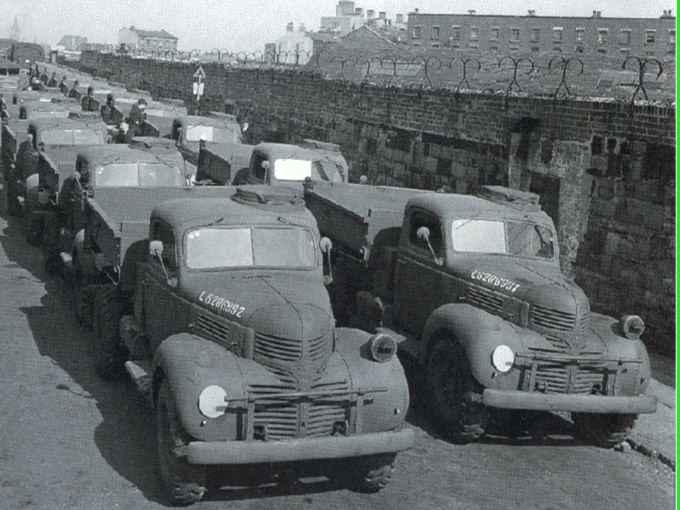
Original caption: "2-41 RVA chauffeur-seiner Maap Los, Soebang, 1949". The unit is Dutch 41 RVA (Regiment Veldartillerie), while the vehicle is a CMP 15 CWT 4X2 and is most likely the Chevrolet version.  Probably ex-Australian. The Ford and Chevrolet trucks shared a standard cab design, which evolved over the years of production. The first (designed at Ford by Sid Swallow), second and third cab designs were called No. 11, 12 and 13, respectively. The first two type were similar, the main difference being a two-part radiator grille in No.12 cab (its upper part was opened with a bonnet, which was known as the "Alligator cab"). The final No. 13 cab, an entirely Canadian design made from late 1941 until the end of the war, had the two flat panes of the windscreen angled slightly downward to minimize the glare from the sun and to avoid causing strong reflections that would be observable from aircraft. All the CMP cab designs had a short, "cab forward" configuration that gave CMP trucks their distinctive pug-nosed profile. This design was required to meet the original British specifications for a compact truck design that would be more efficient to transport by ship. The specifications also demanded right-hand drive. Internally the cab had to accommodate the comparatively large North American engines and it was generally cramped.[5] The standard cabs were then matched up with a variety of standard chassis, drive trains and body designs. Chevrolet-built vehicles could be recognised by the radiator grille mesh being of a diamond pattern, whereas Ford-built ones had grilles formed of a square mesh.


Source :
http://www.41afdva.net/Fotos_41%20RVA.htm
https://en.wikipedia.org/wiki/Canadian_Military_Pattern_truck

Sunday, April 19, 2015

CMP (Canadian Military Pattern) 30cwt Truck


The Canadian Military Pattern (CMP) truck was a class of military truck - of various forms - made in large numbers in Canada during World War II to British Army specifications for use in the armies of the British Commonwealth allies. Standard designs were drawn up just before the beginning of the war.

CMP trucks were also sent to the Soviet Union following the Nazi invasion, as part of Canada's Gift and Mutual Aid program to the Allies. During the War CMP trucks saw service around the world in the North African Campaign, the Allied invasion of Sicily, the Italian Campaign, the Russian Front, the Burma Campaign, the Battle of the Philippines (1941–42), the liberation of Northwest Europe, and the Western Allied invasion of Germany. CMP trucks also saw service in post-war conflicts in Indonesia, French Indochina, and the Portuguese colonies in Africa.


The ambulance is a CMP (Canadian Military Pattern) 30cwt.  Many were taken over by the Dutch after World War II and some were used by their NICA forces.  It is difficult to tell the Ford from the Chevrolet versions unless you have a very detailed photograph. Both companies used their own chassis and engine/transmission/drive lines to mount a wide variety of common design (pattern) bodies on several different sizes of truck.  15cwt, 30cwt and 3 ton were the common ones. The picture was taken at Purworejo, 1 December 1948


Source :
http://en.wikipedia.org/